

1.-Chance Abner Benaim – Panama, Mexico – 90 mins
The luck of the self-absorbed upper-class Gonzalez-Dubois family, is about to change. In this the raucous revenge comedy, Fernando’s a hard-charging politician promising to be “a man of the people” if elected, has secretly burned through the family fortune of shopaholic wife Gloria. Their twin teenage girls are pampered tramps, and their son, Daniel, is more or less being raised by long-suffering maids Paquita and Toña. When the family tries to leave for a Miami shopping spree despite being seven weeks behind on wages, the help revolts and takes everyone hostage. Class conflict is a hot button issue in Panama as elsewhere, and genuinely edgy social comedy is a tricky thing. (In Spanish and English with English subtitles).

2.-Flamenco, Flamenco Carlos Saura – Spain – 101 mins
To explore Spanish music and dance through the eyes of revered master director Carlos Saura is to indulge in as immersive a visual and aural experience as cinema has to offer. Flamenco, Flamenco is his 10th film on the subject in nearly 40 years, and features 21 practitioners performing in traditional and more innovative styles, including Paco de Lucia, Manolo Sanlucar, Estrella Morente, and Eva Yerbabuena. Photographed over seven weeks on a former Seville Expo ’92 pavilion, the film is Saura’s sixth collaboration with the great cinematographer Vittorio Storaro. It employs a velvety rich color palette and scrims of classic European paintings featuring assertive women to create a stunning world of movement, light, and sound. “Flamenco is at a fantastic moment,” Saura told The New York Times in February. (In Spanish with English subtitles).

3.-For 80 Days Jon Garaño, José Maria Goenaga – Spain – 104 mins
Two women who were best friends in high school meet again by accident 50 years later. Now 70, Axun (Itziar Aizpuru) is living a quiet life with her husband on a farm. Maite (Mariasun Pagoaga), on the other hand, has become a successful world traveler. Through flashbacks, we see the deep and yet illicit relationship the young girls developed before being pulled in different directions. Maite’s reappearance forces Axun to reassess her life and the choices she is made —and possibly make some difficult new choices. (In Basque with English subtitles)

4.-Hostage of Illusions Eliseo Subiela – Argentina – 80 mins
This sexy puzzler from Filmfest DC favorite Eliseo Subiela begins with a graying novelist’s escape from a mob. It turns out that the people chasing Pablo are cast-off characters who are disappointed that he won’t continue writing their lives. He bars them from his studio but later opens the door to Laura, a beauty who’s half his age. She used to be his student and now is determined to become his lover. Pablo doesn’t resist; his marriage has long been sexless. Laura soon shows signs of paranoia, which may be justified: her domineering father is a former military man who served during the period of the Argentine government’s greatest crimes. Maybe Laura really is emotionally ill— or perhaps she’s just the most difficult of Pablo’s characters. Writer/director Subiela leaves the outcome open for discussion, but one thing is never in doubt: the film’s erotic charge. (In Spanish with English subtitles).

5.-The Life of Fish Matias Bize – Chile – 83 mins
Although exciting young Chilean director Matias Bize is often compared to Richard Linklater for the emphasis on language and dialogue in his films (which include In Bed (FFDC 2006) and About Crying), in The Life of Fish he comes into his own as Chile’s own Eric Rohmer. About to leave Santiago for his new hometown of Berlin, travel writer Andres impulsively stops by a birthday party populated by old friends. Moving leisurely in and out of discussions on friendship, sex, and roads not taken, Andres eventually encounters former flame Bea, now married with twins. But is their relationship really over? “Who cares about other people’s lives?” someone asks, bewildered that the minutiae of daily living could ever matter. Yet in Matias Bize s world, as in those of many of cinema s most distinctive filmmakers, these details become grist for the mill of probing, lasting drama.
6.-Lope Andrucha Waddington – Spain, Brazil – 106 mins
The world of late-16th-century Spain is brought to vivid life in this account of the poet and playwright Lope de Vega, who wrote 4,000 poems and 800 plays in his very active lifetime. When he isn’t daring to rewrite his contemporary Cervantes, the dashing Lope (enthusiastically and lustily portrayed by Alberto Ammann) clashes with the established power brokers of the theater world and its aristocratic patrons. He also finds time to cavort dangerously with various women of the upper class, including Paquita (Sonja Braga), the imperious daughter of the man who can make or break Lope’s career, and Isabel (Leonor Watling), who is betrothed to a powerful marquis. Director Waddington makes stunning use of exquisite costumes, sets, and locations to deliver a thoroughly believable window into the past and breathes life into one of the key figures of Spanish literature’s Golden Age. —Dave Nuttycombe. In Spanish with English subtitles

7.- Nostalgia for the Light Patricio Guzman – France, Germany, Chile – 90 mins
Chile’s isolated Atacama Desert offers an excellent vantage point on the past. The dark sky attracts astronomers, who have built some of the world’s most sophisticated observatories in a quest for information about the universe’s origins. The dry, salty terrain preserves ancient mummies and petroglyphs, but the region also holds memories that are more recent and more raw: this is where Pinochet’s regime built its largest concentration camp and buried many victims of summary executions. As astronomers gaze into the vastness, relatives brush the dirt for pieces of bone and fabric. This documentary skillfully weaves these themes, which overlap in part because of the widespread effects of Pinochet’s rule; some of the astronomers interviewed here recount childhood exile or how the junta took their parents. From the creation of calcium to the relative speed of light, the film keeps making provocative connections between science, history, and daily life. (In Spanish and English with English subtitles).
8.-October Daniel Vega, Diego Vega – Peru – 83 mins
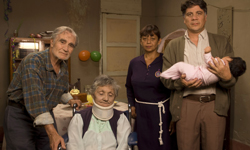
In October, a reserved Lima moneylender learns a bit about life as he cares for an infant who’ s been thrust upon him. The film is precision deadpan in the vein of Bresson, Kaurismaki, and Jarmusch from the preternaturally talented brother team of Daniel and Diego Vega. Known as tough but fair, Clemente sees clients in his living room and regularly visits a local brothel. One day he finds an abandoned infant in his shabby house, probably left by an impregnated prostitute. Enlisting the aid of his devout spinster neighbor Sofia to care for the child, Clemente sets off in search of the mother. Slowly, the mismatched pair begins to resemble a family of sorts. With its name derived from the month in which Sofia’s cherished Our Lord of the Miracles religious procession takes place, the taciturn dramedy October has garnered praise at film festivals from Cannes to Palm Springs.

9.-Easy Money Daniel Espinoza. – Suecia – 124 min.
Serbs, Swedes, Arabs, Albanians, Mexicans, Norwegians, and Danes converge and battle for supremacy in the European drug trade in Daniel Espinosa’s stylish and tense thriller. Intricate deals and double deals play out through the lives of three men and their complicated relationships with their families and loved ones. Jorge has just escaped from prison and holds the key to a massive cocaine shipment. Hard-edged Serbian enforcer Mrado hunts Jorge on orders from rival gangleader Radovan while trying to keep his young daughter safe. Unwittingly stumbling into the middle is mild-mannered business student J.W., who drives a taxi to support himself while partying the night away with his rich friends. J.W. lies and charms his way into this upper-class club and will do anything to belong, eventually joining in a plot to launder drug money. The title is ironic, as nothing is easy in director Espinosa’s well-crafted world. (In English, Swedish, Serbian, and Spanish with English subtitles).

10.- Black Bread Agustí villaronga –Spain- 108 min.
Black Bread won top film and director at this year’s Goya Awards (Spain’s Oscars®). In the harsh post-Civil War years in rural Catalonia, a father and son are viciously attacked. The violence is witnessed by 10-year-old Andreu (Francesc Colomer). Leaning over the dying boy, Andreu hears him whisper “Pitorliu,” the name of a monster supposedly haunting the village. When Andreu s father (Roger Casamajoer) is accused of the murder, the boy sets out to find the real killers and brings to light long-hidden secrets in a world nourished by lies, myths, and wicked revelations. Agusti Villaronga’s adaptation of a novel by Emil Teixdor keeps the story moving relentlessly to dark and sinister places. (In Spanish with English subtitles).
 SCREENPHILES
One thought on “25th FILM FEST DC Films from Latin America and Spain”