
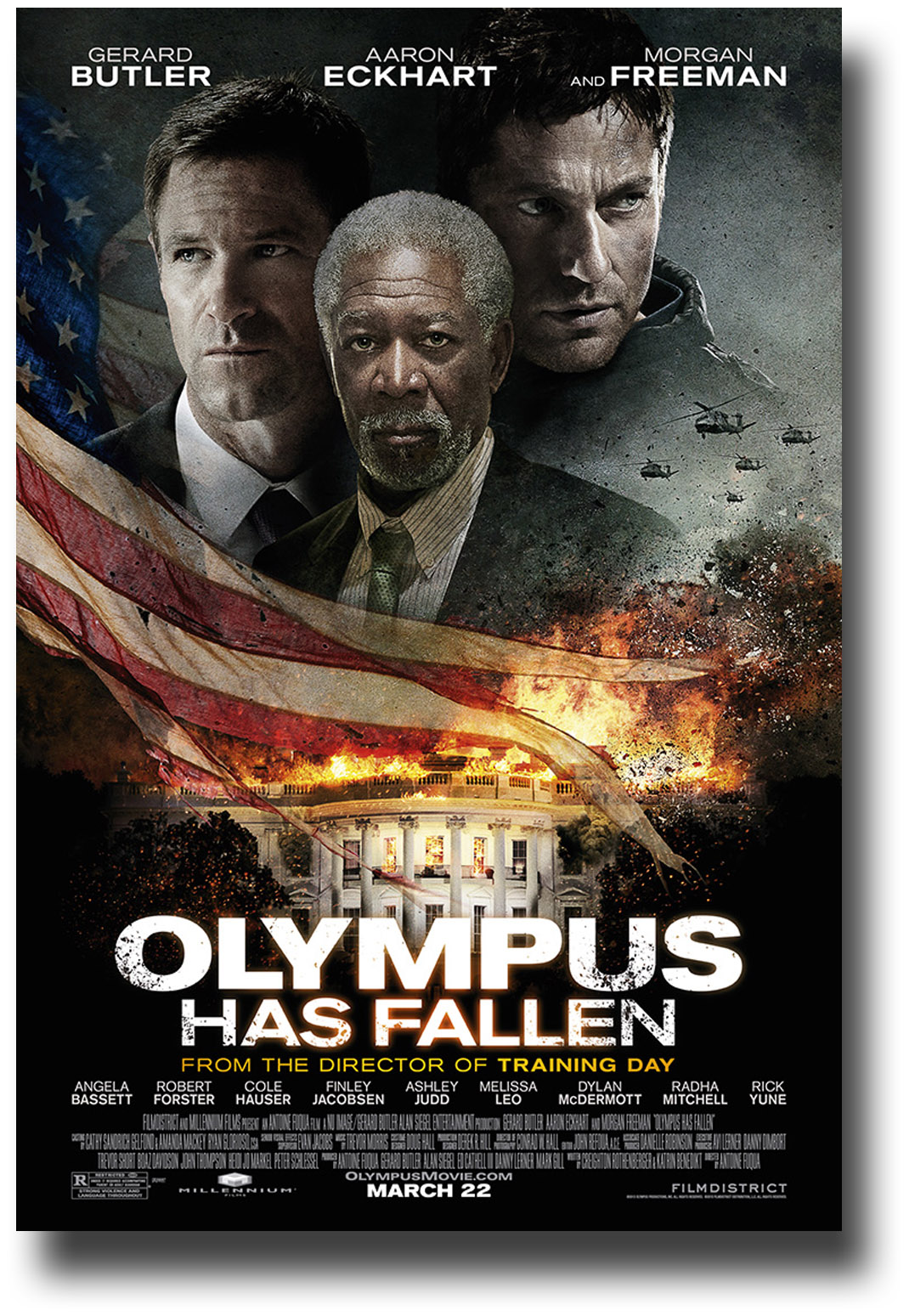
Mount Olympus was the home of the Greek gods, where they ruled over all mortals (these deities never seemed to acknowledge any people other than Greeks, implying that Greece was somehow the center of all creation, and the pinnacle of their handiwork).
Minor spoilers begin.
That ‘Olympus Has Fallen’ is code for the White House being overrun is perhaps the straw that breaks the camel’s back, and it doesn’t take the Oracle of Delphi to know that a reckoning is coming. That reckoning comes in the form of a terrorist attack that our intelligence services suspect may be connected somehow to North Korea. The leader of this effort, a North Korean, is played by Rick Yune, who while he seems to be sanctioned by no government, intends to make the United States suffer in a similar fashion as he believes North Korea has suffered over the years.
What’s interesting is that Yune plays an vaguely similar role in Lee Tamahori’s mediocre–though before “Skyfall” the most profitable James Bond film ever– “Die Another Day.”
Minor spoilers end.
“Olympus Has Fallen” is the latest film by Antoine Fuqua (“Brooklyn’s Finest,” “Shooter,” “Training Day,” “The Replacement Killers,” etc) which some critics have compared to the original “Die Hard,” and while that’s valid on some levels, it misses the mark on others.
For instance, ‘Olympus’ is not only signficantly more violent than “Die Hard,” it’s also more explotative and normally not quite the film that I enjoy watching.
Somehow–and I am not quite sure how the filmmakers pulled it off–the film comes out not nearly as cynical as it could have been.
But strangely enough, I really liked this movie, propagandistic aspects and all. Perhaps because it spends the absolute minimum amount of time introducing viewers to Agent Mike Banning (Gerard Butler) and other pivotal characters before all Hell breaks loose.
The scenario–a military force invades the White House–probably isn’t as plausible as it’s made to seem, though the attack does proceeds with a certain logic, and moves efficiently enough that it takes awhile to notice the the occasional lapse in logic.
Masterfully directed by Antoine Fuqua, though the editing by John Refoua also deserves props, because, as I implied earlier, if the camera were to linger too long, it would perhaps reveal who was behind the curtain.
The film isn’t perfect (some of the CGI looks a bit wonky) but that’s a minor complaint for perhaps the most thrilling film that I have seen in months. What’s also neat is that it doesn’t try to sneak in a plug for a sequel, which I regret because I would really like to see some of these characters again.
 SCREENPHILES