
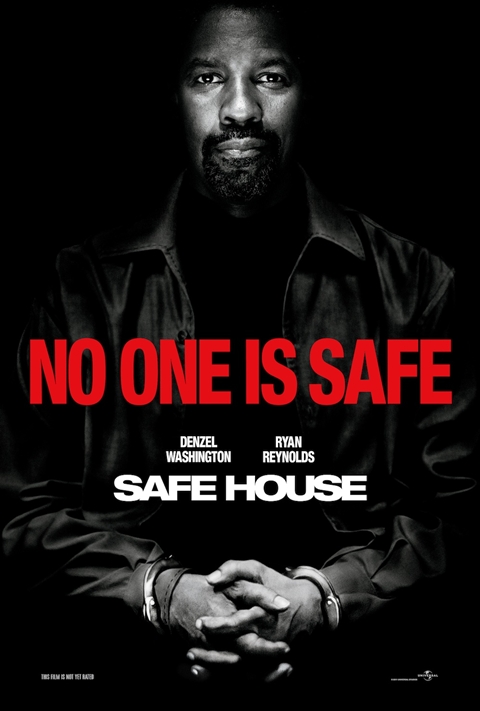
A few weeks ago a co-worker and I were discussing the Daniel Espinosa’s “Safe House,” which we both liked, though he raised a point that I probably would have noticed if the film weren’t as entertaining as it ended up being.
That point he made was that the central premise of the film, that Denzel Washington‘s character was on the run with a flash drive that held information that some in the American intelligence community were willing to kill for, made little sense.
Though it bears mentioning that could have been why someone with the magnetism of Washington was in the lead in the first place: You tend to just sit back and enjoy the ride, as opposed to watching the wizard behind the scenes, manipulating his levers and dials.
I mention this because the film, as far as I could tell, took place in modern times, as in 2012, so there’s no way that anyone could tell me–if they had data that they didn’t want someone else to find–that they would rely on a flash drive that could easily be lost (I know this from experience because for awhile I couldn’t hold on to the damned things to save my life) or damaged somehow.
Heck, there’s Dropbox (which existed when the film was released) which means that I could have a computer in Cape Town, South Africa, and send that data to virtually any person (who had a Dropbox account, but that’s a small matter) that I wanted. I am assuming that Dropbox is available in South Africa, though if it isn’t I know for a fact that filesharing services are, which would be the ultimate in hiding in plain sight.
Your data would be floating somewhere in cyberspace, and despite the computational power at the CIA’s disposal, I suspect that they would never be able to find it if they were not directed to it.
In hindsight, the point I raised above are fairly obvious, but all that star power on display managed to obscure it.
 SCREENPHILES