
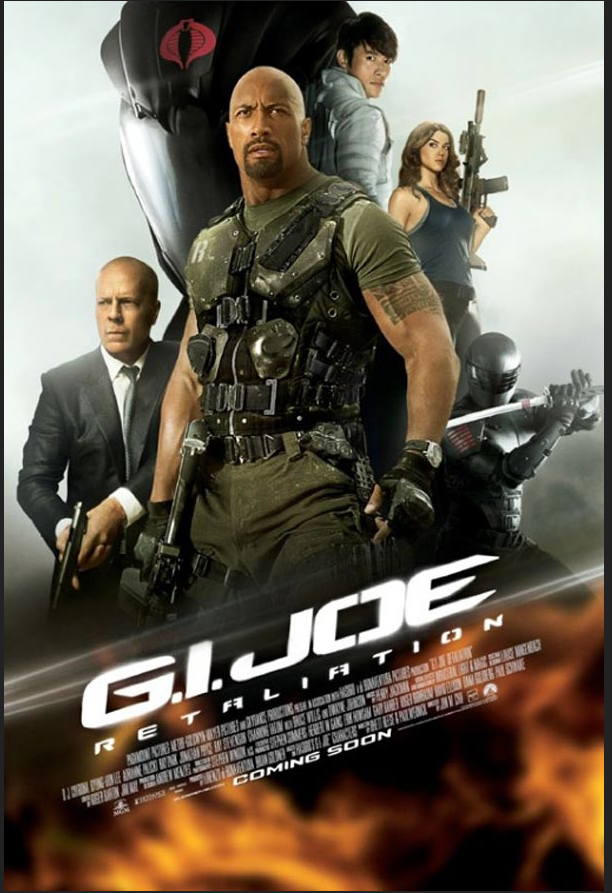
“”G.I. Joe: Retribution” isn’t a good film, though there’s enough things blowing up on screen to keep everyone entertained (which is kinda sad when you think about it).”
To enjoy genre films, be they scifi, horror, fantasy, or anything for that matter, it’s necessary for the viewer to accept that the world that the story takes place in as real.
And I don’t mean “real” in the sense that you leave the theater expecting to see Iron Man or Jason–Bourne, Voorhees, or accompanied by the Argonauts–to come strolling down the street.
Instead, within the confides of the theater, alone in the dark, you make a pact that if the filmmakers have written their characters well enough, and if the world that they exist in makes some sort of sense–no matter how strange it may appear at first glance–with logical, consistent rules, that you’ll go along with the more extraordinary aspects of the character.
But there are loopholes, ways to avoid things like consistent storytelling, if you know how.
One of these loopholes I like to call the ‘Michael Bay Exception.’
The ‘Michael Bay Exception’ postulates that you can have a story as thin as a single ply of toilet paper if you’re able to distract people from that fact by blowing something up spectacularly, and often. It works even better if combine the explosions with lots of beautiful, half-dressed, (and unattainable) women or men.
This is the kung fu that John Chu, the director of “G.I. Joe: Retribution” has learned.
And his kung fu is strong because after this movie ended only two things remained in my head: How little of what I just saw made any sense, and how did I get outside the theater?
Honestly, it wasn’t that bad, but it was close.
‘Retribution’ was a little grittier than in the first film, Stephen Summers’ “G.I. Joe: The Rise of Cobra,” and a little less enamored of CGI, though I think that that may have had more to do with the smaller budget of Chu’s film. I think that he also staged more fights than Summers did, though Chu seemed in search of a dynamic way of doing so though, in the case of a pivotal battle between Storm Shadow and Snake Eyes, it felt choppy, when fluid was probably what he was aiming for.
Speaking of staging fights, pay attention to a particular speedboat battle between Roadblock (Dwayne Johnson) and Firefly (Ray Stevenson) toward the end of the film because it looked like a few frames of it went missing.
Another interesting point is that I read that the film had reshoots because they wanted more of Duke (Channing Tatum). If that’s the case he must have been killed off really, really early because I don’t think he made it to the second third of the movie.
But as I said, when his kung fu was strong, like when people were darting about on lines thousands of feet above the ground, in defiance of both logic and common sense, it was almost enough to make you forget what fell flat prior.
Then, for some reason, on occasion John Chu felt the need to tell a somewhat linear narrative, which coincidentally was when the film began to run out of gas. I also get the feeling to have Bruce Willis star as the original G.I. Joe may not have been the director’s decision, and to do so felt more like a lack of faith on the studios’ part than anything else.
Other than that, the Michael Bay Exception ruled, and things blew up good.
And I was OK with that.
 SCREENPHILES